
 5 star rated
 Fully Accredited
 60+ years’ experience
 100% customer satisfaction
 Always happy to help


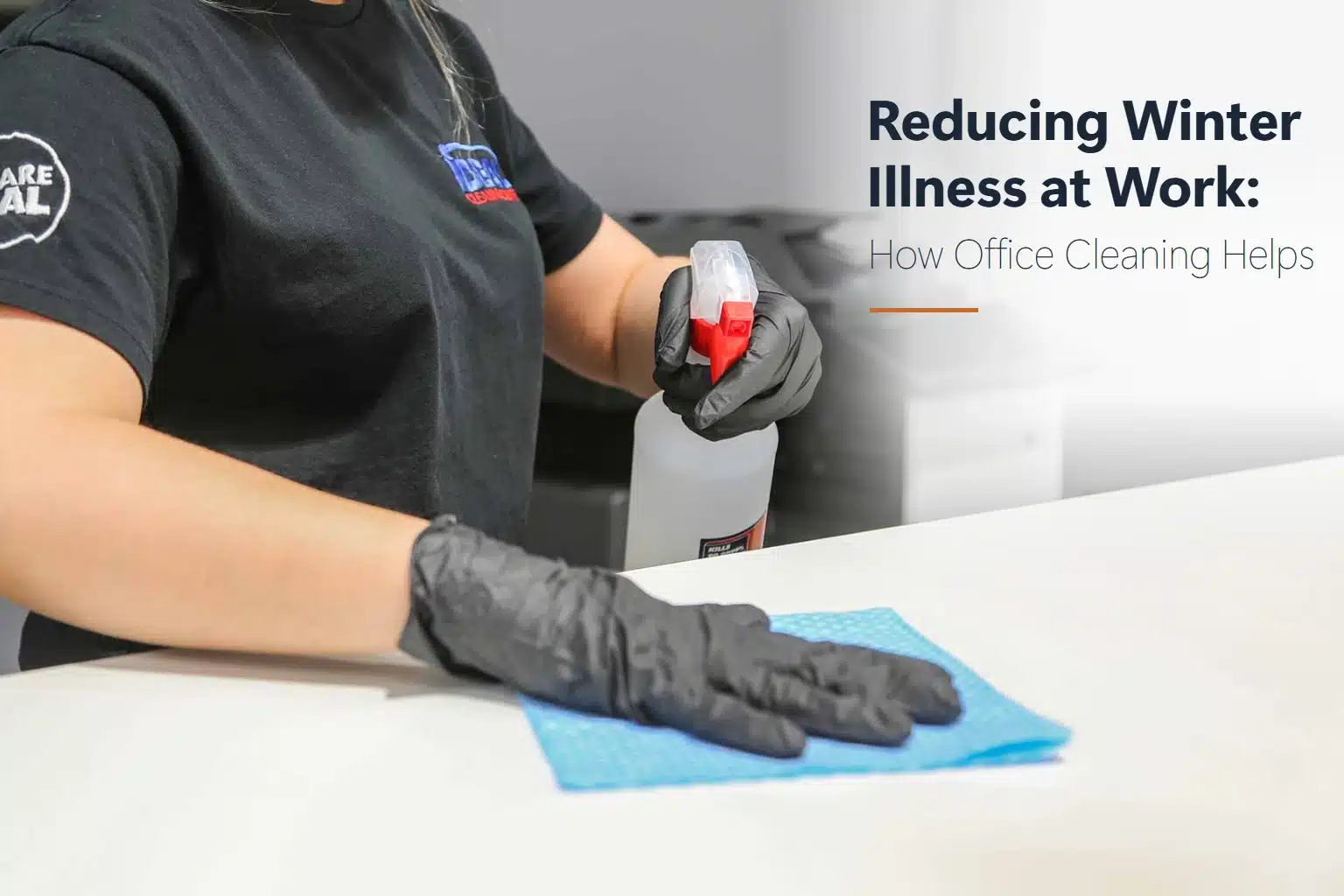
It usually starts with one person. A cough on Monday, a few sniffs in the kitchen on Tuesday, and by Friday a third of the team has emailed in sick. Every office manager knows the pattern, and winter illness costs businesses more working days than almost anything else.
Cleaning will not stop a virus on its own, and anyone who tells you otherwise is overselling. But a lot of winter illness moves around a building on hands and surfaces rather than through the air, and that route is one you can do something about. Here is how professional office cleaning helps, where it makes the biggest difference, and what your team can do alongside it.
Why winter illness hits offices so hard
Minor illnesses, the category that covers coughs, colds, flu, sickness and diarrhoea, were the most common reason for sickness absence in the UK in 2025, accounting for 30.4% of all occurrences according to the Office for National Statistics. The CIPD’s 2025 Health and Wellbeing at Work report puts average absence at 9.4 days per employee per year, the highest in more than 15 years, and 78% of organisations name minor illness as the main cause of short-term absence.
Winter concentrates the problem. The heating goes on, windows stay shut and people spend longer indoors, closer together. Flu and other respiratory viruses circulate most heavily between November and February, and norovirus is known as the winter vomiting bug for good reason.
Then there is presenteeism. Plenty of people come into work with a cold rather than take a day off, which is well meant and not much help to the colleagues they share a kettle with.
How bugs actually travel around an office
Winter viruses spread in two main ways. Some of it is airborne, carried on droplets when someone coughs, sneezes or simply talks. Cleaning does nothing about that, which is why ventilation matters. We covered short, sharp airing in our guide to preparing your workplace for autumn.
The rest moves by contact. Someone coughs into their hand, opens the kitchen door, fills the kettle and goes back to their desk. The next person touches the same handle and the same kettle, then rubs their eyes or eats a biscuit. In an office there are hundreds of surfaces that play a part in that chain.
How quickly it happens surprises most people. In a University of Arizona study, researchers placed a harmless tracer virus on a single door handle or tabletop at the start of the working day. Within two to four hours it was found on between 40% and 60% of the surfaces they sampled around the building. A follow-up study in 2019 found the most contaminated spots were the break room fridge, drawer handles and taps, the push bar on the main exit, and the washroom soap dispensers.
Survival times make it worse. Public health campaigns have long warned that flu germs can live on hands and hard surfaces for up to 24 hours. Norovirus is tougher still. It can survive on surfaces for days, and UKHSA advises that alcohol-based hand gels do not kill it.
What professional office cleaning does differently
Most offices get cleaned. The question is whether the cleaning is designed around how illness spreads, or just around how the place looks. A tidy office with a sticky kettle handle is still passing germs round. These are the differences that matter.
Touch points are a scheduled task, not an afterthought
In a lot of cleaning schedules, door handles and light switches get done if there is time at the end of the shift. In ours, touch point cleaning is a named task with its own list, frequency and sign-off. Through the winter months it is often better value to increase that frequency, or add a short midday touch point visit, than to add another full clean.
Cleaning first, disinfecting second
Disinfectant does not work well on a dirty surface. Grease, dust and residue shield germs from the chemical, so surfaces need cleaning first and disinfecting second. Most disinfectants also have a contact time, the period the surface has to stay wet for the product to work. A quick spray and an immediate wipe achieves far less than people assume. Trained cleaners know the difference. A well-meaning colleague with a pack of wipes usually does not.
The right product for the right bug
General-purpose cleaners remove dirt, but they are not all designed to kill viruses. For norovirus in particular, chlorine-based disinfectants used at the correct dilution are the recommended choice. Using the right product in the right place, at the right strength, is a large part of what you are paying a professional for.
Colour coding stops cross-contamination
Professional cleaners follow the BICS colour-coding system: red cloths and equipment for washrooms, blue for general office areas, green for kitchens and food areas, and yellow for clinical areas. It is simple, and it means the cloth that cleaned the toilet never goes anywhere near the kitchen worktop or your desk.
Fresh cloths and the right equipment
One cloth working its way around a whole floor just moves germs from one desk to the next. Professional teams use microfibre, which lifts and holds far more soil than cotton, change cloths between areas, and launder them properly between shifts.
It gets done every time
The biggest difference is consistency. Schedules, checklists and supervision mean touch points are cleaned on the busiest Friday in December as well as on a quiet Tuesday in July.
The areas that matter most in winter
If you focus on a handful of places, make it these:
- Kitchens and break rooms. Kettles, fridge doors, microwave handles, taps, coffee machines and cupboard handles. Shared dishcloths and sponges are a particular problem and are better replaced with disposable cloths or a daily laundered supply.
- Washrooms. Taps, flush handles, cubicle locks, door handles and dispensers. Soap that runs out by Wednesday afternoon undoes a lot of good work elsewhere.
- Entrances and corridors. Push plates, door handles, handrails, lift buttons, access keypads and visitor sign-in screens. Everyone in the building touches these.
- Desks and shared kit. Hot desks, keyboards, mice, phones, headsets and meeting room tables, along with remote controls and whiteboard markers.
- Shared machines. Printer and photocopier panels, vending machines and water coolers.
Our tips on keeping office toilets clean and fresh go into washrooms in more detail.
When a stomach bug goes round
Norovirus spreads quickly and needs a different response from a routine clean. If someone has been sick at work, or several people are off with diarrhoea and vomiting, the affected areas need cleaning and then disinfecting with a chlorine-based product, paying particular attention to washrooms, kitchens and the touch points between them.
UKHSA advises that people stay off work until 48 hours after their symptoms stop, and that hands are washed with soap and warm water rather than relying on alcohol gel.
For an outbreak, a one-off disinfection and sanitation treatment or a deep clean resets the building. Fogging helps reach surfaces that are hard to treat by hand in the time available, but it works alongside proper manual cleaning rather than replacing it.
Cleaning works best when your team helps
The 2019 office study is worth a closer look. The intervention combined disinfecting high-touch surfaces with giving staff hand sanitiser and wipes, and it cut virus levels on hands and surfaces by an average of 85%. Clean surfaces and clean hands work as a pair. Neither does the job alone.
A few things that cost almost nothing:
- Bring back the “Catch it, bin it, kill it” message: tissues for coughs and sneezes, straight in the bin, then wash your hands.
- Put hand sanitiser at entrances, kitchens and meeting rooms, and keep soap and paper towels stocked.
- Ask people to clear their desks at the end of the day. Cleaners cannot clean a desk buried in paperwork.
- Encourage people to stay at home when they are unwell, or to work from home where that is possible.
- Air rooms with short bursts of fresh air rather than keeping everything sealed all day.
Is it worth the extra cost?
For most businesses the sums are not complicated. A single day with a quarter of the team off sick usually costs more than a winter’s worth of extra touch point cleaning. You do not need to double your cleaning budget. Shifting effort towards the surfaces that spread illness, for the months when winter illness peaks, is normally enough to make a real difference.
If you are not sure how often your office should be cleaned in the first place, our guide on how often commercial cleaners should clean your office is a good place to start.
Frequently asked questions
How often should office touch points be cleaned in winter?
At least daily. High-traffic touch points such as main door handles, kitchen surfaces and washroom taps are worth cleaning more than once a day during flu season or when illness is going round the office.
Does normal cleaning kill norovirus?
Not reliably. Many general-purpose cleaners and alcohol-based products are not effective against norovirus. Chlorine-based disinfectants, used at the correct strength and left for the right contact time, are the recommended choice.
Is fogging worth it during flu season?
Fogging is most useful after an outbreak, or for large and hard-to-reach areas. It is a good addition to regular cleaning but should not replace it.
Can you clean outside office hours?
Yes. We work 24/7, including weekends and holidays, with no additional call-out fees, so your office can be cleaned and disinfected without disrupting your team.
Winter-ready office cleaning across Teesside
Ideal Cleaning Centre is a family-run business that has been cleaning workplaces across the Tees Valley since 1958. We provide professional office cleaning for businesses in Middlesbrough, Stockton, Hartlepool, Darlington, Redcar, Durham and Sunderland. Our team are BICS trained and City and Guilds qualified, and we are NCCA members, SafeContractor Approved, SafePQQ Verified and Trading Standards Approved.
If you want your office ready for the worst of the winter, book a free workplace cleaning health check, call 01642 685 321, email team@idealcleaningcentre.co.uk or request a free quote.